
Feather Flags vs. Teardrop Flags: Shape, Wind Performance & Visibility
Introduction
If you've ever stood in a parking lot watching a row of tall, fluttering flags wave shoppers toward a grand opening, you've seen the quiet workhorse of outdoor marketing. Custom flags are cheap to print, easy to set up, and impossible to ignore. But once you start shopping, you hit a fork in the road: feather flags or teardrop flags?
They look similar at a glance, and a lot of buyers treat them as interchangeable. They aren't. The two shapes behave differently in the wind, carry different amounts of artwork, and read differently from a distance. Pick the wrong one, and you either lose your message in a breeze or watch your flag droop on a still day. This guide breaks down the real differences so you can choose with confidence.
The Quick Answer
If your top priority is maximum message space and dramatic movement, go with a feather flag. If your top priority is staying readable in strong winds and holding shape on calm days, go with a teardrop flag. Most businesses end up choosing based on where the flag will live and what the weather is like there.
That's the short version. The details below explain why.
What Is a Feather Flag?
A feather flag (sometimes called a quill, swooper, or blade flag) is tall and narrow, with a gently curved top edge that tapers like the tip of a feather. The fabric is sewn into a sleeve that slides over a flexible fiberglass pole, and the top of the flag is free to sway with the wind.
Feather flags are the tallest option in the category, commonly reaching 8 to 17 feet depending on the kit. That height is their headline feature. They tower over car roofs and shrubbery, and the loose top edge gives them a lively, rippling motion that the human eye is hard-wired to notice.
What Is a Teardrop Flag?
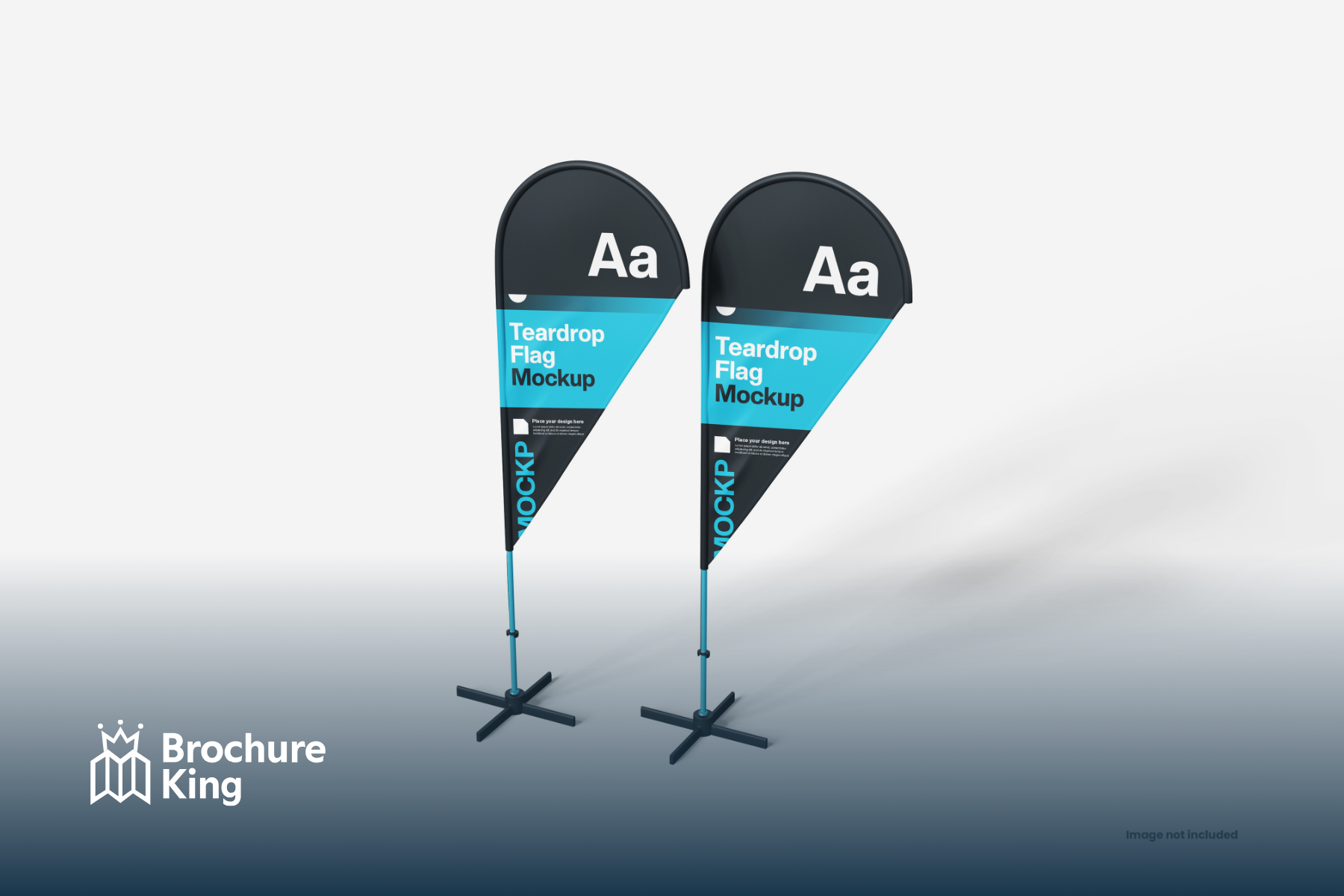
A teardrop flag is shaped like a raindrop, wide at the top and curving down to a point near the pole. The defining difference is structural: the fabric is held taut on two sides by a curved pole assembly, so the flag keeps its shape even when the air is dead still.
Because the fabric is stretched and anchored, a teardrop flag behaves more like a rigid sign than a loose banner. It tends to be a little shorter and more compact than a feather flag, which is exactly why it stays composed when the wind picks up.
Shape and Print Area: Where Your Message Lives
This is the difference designers notice first.
A feather flag gives you a long, vertical canvas. That tall, slim shape is excellent for stacked words and short phrases read top to bottom: OPEN, SALE, NOW HIRING, GRAND OPENING. You get more linear height, so a multi-word message can breathe.
A teardrop flag gives you a rounder, more contained shape. There's less vertical room, but the wider belly is genuinely great for a logo, a single bold word, or an icon-driven design. The artwork sits within a frame that always holds its form, so a logo never gets distorted by a flapping edge.
In our print work, we've seen this play out clearly: clients who send us logo-forward designs almost always look sharper on teardrops, while clients with vertical text or a tall product photo get more impact from a feather flag. When a customer can't decide, the artwork usually decides for them.
Wind Performance: The Real Deciding Factor
Here's where the two shapes genuinely part ways, and it's the question we get asked most.
Teardrop flags win in the wind. Because the fabric is tensioned on a curved frame, it doesn't have a loose edge to catch gusts and wrap around the pole. The flag holds its shape, your message stays facing forward, and the whole unit puts less strain on the pole in a strong breeze. For coastal locations, open highways, exposed rooftops, and anywhere the air really moves, teardrops are the more dependable pick.
Feather flags trade stability for motion. Their free top edge is what makes them so eye-catching, but it's also what makes them flutter, ripple, and occasionally wrap when the wind is high. On a calm day, a feather flag can sag, and the message can collapse on itself until a breeze lifts it. That's not necessarily a flaw. Plenty of businesses love the energetic, waving look, but you should know what you're signing up for.
We've heard from a customer in Chicago, a city famous enough for its wind to have earned a nickname, who ran feather flags outside a weekend market and found them constantly tangling around the poles. Switching to teardrops solved it overnight: the flags stayed upright and legible through gusts that had previously flattened the feathers. It's a clean illustration of the rule: the harder the wind, the more a teardrop earns its keep.
A simple way to remember it: feather flags dance, teardrop flags stand.
Visibility and Readability From a Distance
Both shapes are designed to grab attention, but they do it in different ways.
Feather flags win on sheer height and motion. From far down a road, a tall flag swaying above traffic is one of the first things a driver registers. If your goal is to be seen from hundreds of feet away and pull people in from the street, height is your friend.
Teardrop flags win on consistent legibility. Because the fabric never collapses or twists, your logo or word stays readable at every moment, not just when the wind is cooperating. For a busy event with foot traffic passing close by, that reliability often matters more than raw height.
Think of it as reach versus reliability. Feather flags reach farther; teardrop flags read clearer up close and in tough conditions.
Durability, Setup, and Reuse
Both flag types share the same friendly basics: lightweight fiberglass poles, fabric printed by dye sublimation so the ink soaks into the weave and won't crack or peel, and a choice of bases, ground spikes for grass, cross bases or water-weight bags for hard surfaces, and wall or vehicle mounts for special cases. Both pack down into a slim carry bag, and both are reusable season after season if you bring them in during storms.
The practical durability edge usually goes to teardrops, simply because a flag that flaps less also frays less over time. Feather flags can have a slightly shorter outdoor lifespan in windy spots because that constant motion wears the trailing edge. If you plan to leave a flag out daily in an exposed trade show location, that's worth weighing.
Which One Should You Choose? Use Cases That Make It Obvious
Because both flags solve overlapping problems, the cleanest way to decide is by scenario.
Reach for a feather flag when:
You're doing a grand opening, sidewalk sale, or anything that benefits from a tall, animated "look over here" signal.
Your location is reasonably sheltered: a strip mall storefront, an indoor expo hall, a covered entrance.
Your message is short vertical text, and you want it as large and visible as possible from the road.
You're lining up a row of flags to create a rhythmic, festive entrance.
Reach for a teardrop flag when:
Your location is windy or exposed: beachfront, open lot, rooftop, highway frontage.
Your design is logo-led, and you need it to stay crisp and undistorted at all times.
You're running a multi-day event and want zero fuss, no re-staking or untangling.
You're placing flags close to foot traffic where clean, constant legibility beats height.
Many businesses simply buy both: feather flags out by the road to pull people in, teardrop flags at the entrance, and registration tables where close-up clarity counts. They're affordable enough that mixing and matching is a smart, not extravagant, strategy.
Conclusion
Feather flags and teardrop flags are cousins, not twins. Feather flags are taller, carry more vertical message space, and create dramatic movement, but they flutter, can sag on calm days, and struggle in strong winds. Teardrop flags hold their shape in any conditions, stay readable up close, and shine for logo-driven designs and windy locations, while giving you a little less height and print room. Match the shape to your location's wind, your artwork's layout, and how you want people to notice you, and you'll get a flag that works hard for years. When in doubt: feather flags for reach and energy, teardrop flags for stability and clean readability.
Whichever shape fits your campaign, the quality of the print is what turns a flag from background noise into a magnet for attention, and that's where the right print partner makes the difference.
Get Your Custom Flags Printed With Brochure King
At Brochure King, we print vibrant, weather-ready feather and teardrop flags, along with brochures, flyers, posters, rack cards, and the rest of your promotional kit, delivered quickly and affordably across the country. From breezy waterfronts in Miami to the open lots of Dallas and the famously gusty corners of Chicago, we help businesses pick the flag shape that survives their conditions and looks sharp doing it.
Not sure which flag is right for your location or design? Request a quote or contact us today, and our team will help you choose the shape, size, and finish that fit your goals, then turn your artwork around fast.
Frequently Asked Questions
Are feather flags or teardrop flags better for windy areas?
Teardrop flags are better for windy areas. Their fabric is held taut on a curved frame, so they keep their shape and stay readable instead of flapping or wrapping around the pole. Feather flags have a loose top edge that catches gusts, making them better suited to sheltered locations.
What is the difference between a feather flag and a teardrop flag?
A feather flag is tall and narrow with a curved top and a free-swaying edge, giving you more vertical message space and dramatic motion. A teardrop flag is shaped like a raindrop and tensioned on two sides, so it holds its shape in any wind and keeps logos and short messages consistently legible.
Which flag has more space for my design?
Feather flags offer more printable area because of their greater height, making them ideal for stacked vertical text and tall images. Teardrop flags have a more compact, rounded shape that works best for a single logo, icon, or bold word that you want to stay crisp and undistorted.
 Hi! How can we help?